Showing posts with label Marine Fish. Show all posts

Fish Flasher (Paracheilinus Nursalim)


Paracheilinus Nursalim is a new species of fish, found in Indonesia in 2006, also called fish flasher. Paracheilinus Nursalim found in expeditions Rapid Assessment Program (RAP) of Conservation International in West Papua, Indonesia in 2006 (Region FakFak / Kaimana)

Males usually perform ritual where the color awesome fondling 'electric' glow periodically to get the attention of nearby females. Fondling dance performed every day in the afternoon, starting one hour before sunset and continues until dusk.

Mouth and lips that are modified to make the fish can eat, breathe and attached to the surface of the siphon. Parenting adult fish for their eggs, male not female mate then go left, but thrive better where adult males usually guard the eggs and larvae of fish occasionally.


The species was named after the wife of Councillor CI family, Enki Tan, Cherie Nursalim ie. They could be donors Bird Head Seascape, global institute for marine conservation priorities.

This fish has the most spectacular color compared to all other reef inhabitants. His name is derived from courtship behavior
Her unique. Male fish suddenly emit electric neon colors while enforcing fish fins to attract females.


Types of fish are auctioned flasher is considered the most awesome fish of 16 species are known. This fish is found in the stretch of the southern part of Sea Bird's Head, from Raja Ampat to Triton Bay.


 Species is known only from the Bird's Head region in Papua Indonesia, and very little is known of this new species are described. However, given the deep water habitat and small size, and its presence in marine protected areas within a limited range, it is listed as Least Concern.

Habitat This species inhabits semi-sheltered area exposed to periodic strong currents. It is always associated with a gradual slope debris at depths ranging from approximately 5-50 m or more, but are most abundant between 20-35 m. The animals included in the IUCN red list.
Read more »

Royal Dottyback


Royal Dottyback - Blue Eye is a new species of Royal Dottyback. The first time you see it, almost indistinguishable from the Royal Dottyback (Pictichromis paccagnellae) in general. However, upon closer inspection, it will find a unique feature that distinguishes Blue Eye Royal Dottyback for this.

This species is known as the Blue Eye Royal Dottyback from Dottyback family. This fish has a distinctive coloration. Habitat of this species in the tropical waters of the western Pacific. Blue Eye Royal Dottyback can be recognized to have typical coloration. The front of bright purple fish, which then suddenly turns yellow on the back of the fish.


If you want to keep in the aquarium it should be housed in a marine aquarium contains 30 gallons or larger in size. Aquascaped ideal setup should be good with live rock to provide enough options crevices and caves. Food from Blue Eye Royal Dottyback should consist of brine shrimp and prepared frozen foods. To maintain the ideal color.

These fish are strong enough may exhibit aggressive territorial behavior towards conspecifics and better kept alone with the exception of the largest home aquarium. In general, the spirit of the Blue Eye Royal Dottyback of this, have an energetic personality and will not be easily intimidated by other fish and even two to three times its size.
Read more »

Lumba Lumba Pink


Rarely seen a dolphin colored pink bottle nose circulating in a Louisiana lake. These mammals were photographed by local charter boat captain Erik Rue who is studying animal dolphin since it first appeared Calcasieu Lake, a brackish water area is located in the northern Gulf of Mexico, the southwestern USA.

Since it is known to blend in with normal colored dolphins last year, a pink dolphin has invited interest of the arrival of visitors to Lake Calcasieu. Captain Rue (42) first saw the pink dolphins being with a herd of four other dolphins. One dolphin known as the mother who always accompanies her son's pink.

"As painted, the dolphin's body was completely pink. I've never seen anything like this before," said Capt. Rue.

"The Mammals pink ranging from snout to tip of tail and reddish eyes showed albino animals. Smooth pink skin with no spots whatsoever. I've watched about 40 to 50 times since it was first appeared in family groups in Calcasieu Ship Channel. "

Regina Asmutis-Silvia, senior biologist Whale and Dolphin Conservation Society, said the dolphins 'absolutely charming'. "I've never seen a dolphin colored like this during my career," said Regina Asmutis-Silvia.

"People should respect the existence of this animal. Trick is watching from a distance, limit yourself to observe these animals and do not hunt or make distracted," he added.
Read more »

coelacanth


Coelacanth (meaning "thorn hollow", from the Greek word coelia, "κοιλιά" (hollow) and acanthos, "άκανθος" (thorn), referring to the spines fins hollow) IPA: [si ː lə ˌ kænθ] is the name of the order (nation) fish is comprised of an evolutionary branch of the oldest living jawed fish. Coelacanth is estimated to have gone extinct since the end of the Cretaceous period 65 million years ago, until a specimen was found in eastern South Africa, in river waters Chalumna 1938.
 
Since the coelacanth has been found in the Comoros, the waters of the island of Manado Tua in Sulawesi, Kenya, Tanzania, Mozambique, Madagascar and marine parks St. Lucia in South Africa. In Indonesia, particularly around Manado, North Sulawesi, this species by local people called coelacanths. Coelacanth consists of approximately 120 known species based on fossil discoveries.

living fossils


Until now, there have been two species living Coelacanth found the Comoros coelacanth, Latimeria chalumnae and Sulawesi Coelacanth (Manado), Latimeria menadoensis.Until 1938, the fish closely related to lung fish is considered to have been extinct since the end of the Cretaceous Period, about 65 million years ago. Until when a living coelacanth was caught by shark nets in advance Chalumna River estuary, South Africa in December of that year. Trawler captain who are interested in seeing the odd fish, send it to the museum in the city of East London, which was then headed by Ms.. Marjorie Courtney-Latimer. A iktiologis (fish expert) local, Dr. J.L.B. Smith then decrypt the fish and his article published in the journal Nature in 1939. He gave the name Latimeria chalumnae to new types of fish, to commemorate the museum curator and the location of the discovery of the fish.

, In the presence of Ms.. Courtenay-Latimer, curator of the East London museum.]] Searching for locations where ancient fish that lived during the next dozen years and then get water Comoros Islands in the Indian Ocean west as habitat, where several hundred people are estimated to live at ocean depths of over 150 m. Outside the islands, until the 1990s a few individuals also caught in the waters of Mozambique, Madagascar, and South Africa. However, it is still considered part of the population or less the same.

In 1998, sixty years after the discovery of a living fossil coelacanth Comoros, sea king fish caught in fishing nets in the waters of the island of Manado Tua, North Sulawesi. This fish has been long known by local fishermen, but there has not been known to exist by the scientific world. Coelacanths Comoros coelacanth physically similar, with the difference in color. The king of the sea is brown, while the Comoros coelacanth blue steel.

Coelacanths are then sent to an American researcher who lives in Manado, Mark Erdmann, along with two colleagues, RL Caldwell and Moh. Kasim Moosa from LIPI. This discovery was then published in scientific journals Nature.Maka now people know that there is a second coelacanth population, a separate cross the Indian Ocean and the islands in western Indonesia so far approximately 10,000 km. Later, based on analysis of mitochondrial DNA and isolation of populations, some Indonesian and French researchers propose coelacanths Latimeria menadoensis as a new species.

Two years later the group also found that living coelacanth in waters of Marine Protected Areas (Marine Protected Areas) St. Lucia in South Africa. People then realized that the possibility is still there that coelacanth populations elsewhere in the world, including in other parts of the archipelago, given that these fish live isolated in the depths of the ocean, especially around volcanic islands. Until now coelacanth new taxonomic status is still debated.In May 2007, an Indonesian fisherman caught a coelacanth off the coast of North Sulawesi province. This fish has a size of 131 centimeters long with a weight of 51 kg when captured.
 
Another note


Coelacanth characterized ancient fish, like a fan-shaped tail, large eyes, and scales that look is not perfect (like a rock). In Bunaken've discovered a living coelacanth swim freely. Its size is approximately 2/3 the adult body and her dark purple.
Read more »

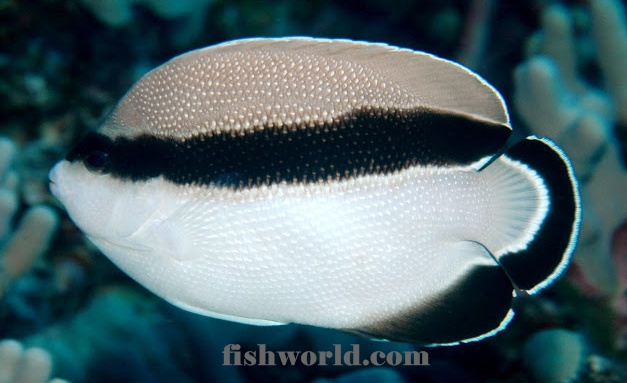
Angelfish Griffis ( Apolemichthys griffisi )


Angelfish Griffis (Apolemichthys griffisi) found within a limited range in the Indo West Pacific. Habitat Angelfish Griffis typical coral and deep on slopes or walls. Although not too flashy in color, Angelfish Griffis has a unique and striking patterns of the signs. It is most suitable for large aquariums without cnidarians or sponges that can tempt Angelfish Griffis to bite.

 
Griffis angelfish often found in coral reef slopes and sharp drop-0ff. They often live in solitary pairs or in small groups and do not migrate. Griffis angel fish live in the depths of 15m to 100m, ideally usually encountered at a depth of 40m to 60m below sea level.


Griffis Angelfish have time to breed between the ages of 1.4 years to 4.4 years. The main food Griffis Angelfish is a sponge and tunicate. It's fun when the ornamental fish Angelfish Griffis which we maintain in the reef aquarium would eat artificial foods like fish pellets.

Apolemichthys griffisi
Scientific classification

Kingdom       : Animalia
Phylum          : Chordata
Class             : Actinopterygii
Order           : Perciformes
Family          : Pomacanthidae
Genus           : Apolemichthys
Species         : A. griffisi
binomial name
Apolemichthys griffisi
Read more »

Ephippidae


Ephippidae is a family of fish that contain spadefishes. There are about eight genera, with a total of 20 species, mostly sea. The most well known coral species in the genus Platax-lived, which batfishes, which is kept as an aquarium fish.


Their shovel-shaped, laterally compressed, and very symmetrical triangular dorsal and anal fins. They are shiny silver with yellow and dark brown field vertical or appeal. Eyes are often located in one of the vertical band as a method of camouflage. Scuba divers sometimes mistake them for angelfish, which is similar in shape but are not closely related. Other genera in the family are characterized by long, trailing, pointed dorsal and anal fins. Most species feed mainly on algae and small invertebrates.


Some spadefishes popular sport fishing catch. The Atlantic spadefish (Chaetodipterus Faber), for example, is a black and white zebra-striped fish common draw just offshore in the southeastern United States and Caribbean. They are favorites because they put up a fight because they stumbled in Spadefish are generally considered to be overfished group. Most of the individuals caught small and young and far from the maximum size recorded for their species.


A recent study in Current Biology (vol 16, p 2434) has suggested that Platus pinnate batfish may play a critical role as a functional group in the Great Barrier Reef by eating seaweed that other herbivorous fish such as parrotfish and surgeonfish will not touch. Overgrowth of seaweed among corals occurs as a result of overfishing of the fish species of corals and inhibit the ability to support life. 
 
Read more »

fish Baronang


Rabbitfish (Siganus sp.) Is a marine fish that includes family Siginidae. Fish beronang recognized by society as different from each other as the Thousand Islands called kea-kea, in Central Java as the guava and the fishermen on the island of Maluku named as the samadar.
 
Rabbitfish found in shallow lagoons in the Indo-Pacific and eastern Mediterranean. this fish in English is called this because rabbitfish eating plants (seaweed) that neatly trimmed like a small lawn machines. Rabbitfish is one fish that is a favorite for anglers at sea.

The characteristics of

                                                                         Wind baronang

Baronang including herbivorous fish, rabbitfish adult fish body length reaches 20-45 cm, body longitudinally and laterally flattened, covered by small scales, small mouth terminal position. Jaws equipped with small teeth. His back is equipped by a sharp spines pointing forward between neural first and usually embedded under the skin. These spikes can be fitted with gland / poison on its tip. Poison is not deadly animals adult human life, but can cause severe pain. although baronang poisonous fish spines but animal meat is safe for consumption.

 Known species

                                                                         rabbitfish Milk

In Indonesia are generally known Baronang milk (Siganus canaliculatus), rabbitfish tompel (Siganus guttatus) and rabbitfish wind (Siganus javus), of the three types that are most common are milk baronang. In addition there are pepper rabbitfish (Siganus stellatus), batik rabbitfish (Siganus vermiculatus), necklace rabbitfish (Siganus virgatus), rabbitfish turmeric etc. however, because the population is rare, the latter species is rare.
Read more »

Banggai cardinalfish


Banggai cardinalfish (Pterapogon kauderni) is a small tropical cardinalfish (familyApogonidae) are very popular used as ornamental fish.

Habitat

This species only Banggai Islands, Indonesia. This species lives on a very limited geographic range is 5,500 km ² and a population of only around 2.4 million. Banggai cardinalfish an isolated population and are concentrated in shallow peraiaran on 17 major islands and 10 smaller islands, Banggai Islands. Some are small populations in Central Sulawesi Luwuk. Additional populations from Lembeh Strait (North Sulawesi), approximately 400 km north of the original habitat (based on reports from fishermen perdagangkannya 2000).

 Description

This species grows to a maximum length of 8 cm has a particular style that contrasts between black and bright white lines. Specific differences that distinguish the cardinalfish other is on the first dorsal fin has pigtails, anal fin and second dorsal fins sticking out the back, forked caudal fin (very deep branches), has a color pattern consisting of 3 pieces of black lines on the head and body, striking black color on the edge of the beginning of the anal fin and the second fin Banggai cardinalfish dorsal.Yang distinguish male and female is the larger male oral cavity and it was only visible when incubating their eggs.

Banggai cardinalfish, species endemic to Indonesia
Banggai cardinalfish Lembeh Strait North Sulawesi

Ecology

Banggai cardinalfish is the only representative of the family are diurnal. Tropical sea demersal fish that form a stable group consisting of 9 individuals in shallow waters (generally 1.5 to 2.5 meters depth). This species inhabits shallow waters with a variety of habitats including coral reefs, seagrass beds, and open areas of sand and rubble bersubstrat, generally in a quiet area protected by the islands. This species is often found associated with the Enhalus acoroides seagrass and sea urchins Diadema setosum. Hi this happened on various benthic substrates such as sea urchins, sea anemones, and coral branching; young fish most often associated with sea anemones, as adolescents and adults associated with sea urchins and coral branching, star lau, hydrozoans, and mangrove prop roots.

Banggai cardinalfish, species endemic to Indonesia
Banggai c ardinalfish at New England Aquarium

This includes fish species opportunistic eaters throughout the day, unlike other species of spessies same family. Composition of diet equal to the size of the class, including plankton and benthic organisms. Copepods is their main food. Copepods are also important sources of food for many species such as lionfish (Pterois), Epinephelus merra, crocodilefish (Cymbacephalus beauforti), moray eel (Echidna nebulosa), stonefish (Synanceia horrida), and sea snakes Laticouda Colubrina.

Banggai cardinalfish is mouthbrooder paternal (male parent incubating eggs). Female parent plays a role in the formation and pair formation, which occurred a few hours to several days before spawning. Couple laying a few feet from the main group and defend their territories. Banggai cardinalfish egg size has a diameter of 2.5 mm. These fish have the short life spans (approximately 4 years in an area with ideal conditions, 2 years in the wild), and the number of eggs a bit (50-90 bouts) r despite having the potential spawn several times a year (after age above 10 months).
 
Read more »

Three Spot dascyllus ( Dascyllus fri )


Three Spot dascyllus (Dascyllus fri) that contained colorful coral; coral, the same shape as ciclid betokpun only one nostril and in front of the anal fin has two spiny fins fan. Three Spot dascyllus (Dascyllus fri) his flat and looked from side round and impressively thick. Body color and jet-black with three white spots, one didahi and one on both sides. Patches are missing after an adult. Rarely exceed 15 cm in length. In betok aquarium look good when placed in groups.

Indonesia Name: Fish Dakocan
English name: Three Spot dascyllus,
Latin Name: Dascyllus fri
Classification: Order Perciformes, Familia Pomacantridae


Behavior: Similar to clone their love playing near the anemones and foraging among the rocks. Living in the herd, and when danger threatens, the entire group herd disappeared into the coral. These fish have a strong territorial behavior. Each fish has a gap still in the coral one and keep it. These fish are not suitable placed the fish bigger.

Reproduction: When reproducing a reddish color silver. When laying, the eggs are placed in clumps on the coral or rocks, and the parent will maintain until the eggs hatch.

Feed: In their natural habitat they like small shrimps, larvae, crabs and often they clean parasites in fish body size larger. While at the aquarium Excited Loka than natural food of fish is also given artificial feed among other things: Tubifex sp, Rotifera sp and sp Apnia.

Habitat: The tropics and typically occupants rocks that extends into the sea up to 55 m.


Read more »

Siganus Vulpinus ( Foxface rabbitfish )


Siganus Vulpinus medium bodied and flat shape visible from the side oval. Body color rear bright yellow. caudal fin and anal fin. Being the head of black and white stripes are impressive fish using a mask on his head. Her mouth is slightly tapered tubular. Small mouth like the mouth salendar tweet rabbits and used to mengunggisi algae. Variety of colors to disguise the true form of this fish. Dorsal fin and anus are poisonous spines can cause painful injuries when hit. 

Indonesia Name: Salendar tweet
English name: Siganus Vulpinus,
Latin Name: Foxface rabbitfish
Classification: Order Perciformes. Singanidae Familia.


Behavior: Lively, like peace, when in disturbed fish dorsal fin growing tip facing toward the attackers. thorns have poison glands which make painful cuts. In the aquarium fish is seen actively swimming in the open and winding track reef holes. Aggressive attitude towards its own kind but is very friendly with other fish.

Reproduction: This fish in their natural habitat by spawning. however, its breeding in the aquarium not known. Gender differences between male fish and female fish are also unknown.

Feed: In the natural habitat of these fish eat a variety of foods such as live mosquito larvae, silk worms. algae and lettuce. While in aquarium fish besides Gembira Loka live feed was given artificial feeding also include such Tubifex sp, Rotifera sp and sp Apnia made ​​pellets.

Habitat: Lake edge and typically inhabit marine rocks that extends
Read more »

Mandarin fish (Synchiropus splendidus)


Mandarin fish (Synchiropus splendidus) is a small brightly colored fish that are included in the familia dragonet, known in the aquarium business. Mandarin fish from the Pacific Ocean, ranging from the Ryukyu Islands to Australia.
 
Characteristics


Mandarin fish has a long body and two dorsal fins. Mandarin fish have stripes of green, orange, and yellow, with a blue wrap his body. Regular mandarin fish eat small crustaceans and other invertebrates.
His life is like playing 'hide-and-seek' in the composition of coral reefs full of loopholes, busy feeding the fish while avoiding predators. Fish that became an icon of the international tourism body at length ranging from 8 to 15 centimeters and are usually out of the reef in search of food only in the morning and evening.

The style and the color is so unique and captivating, like batik patterns with primary colors, while some other types of light green with polka-dot motif. There is also a combination of white chocolate so subtle if 'walk' between the rocks. Bali has a species of sea fish with good color harmony of the world, in addition to bright batik, at the bottom of her neck to light shades of blue to green. Surroundings fins also decorated with sky blue color that is not owned by the Mandarin fish in other waters.

Maintenance


Pisciculture is practically impossible to maintain in the aquarium. Because these fish are difficult to adapt to new environments, sensitive to changes in water and difficult to give her eating because he does not like artificial feed such as pellets of fish, dried worms and shrimp processing factories.

However, there are several ways that can be applied to the successful maintenance of this mandarin fish, among which, creating conditions similar to their habitat aquarium is providing live coral (living rock) a lot of the media where the fish is looking for food. Also do not mix with mandarin fish are aggressive fish in an aquarium, it will make the fish stressed, more calm conditions the fish will the longer the Mandarin fish can be maintained.
 
 
Read more »
Powered by Blogger.