Showing posts with label Sea fish. Show all posts

fish Landuk


Fish Landuk (Lethrinus elongatus) of the family Lethrinidae also recognized as a coney and Luping among the population of Sabah. Landuk physical characteristics are mouthed tapered elongated, brown and white bertompok body, hard and whitish scales below the stomach.

Landuk food is krustasia, juvenile fish, small fish and squid. Landuk at the base of rocky habitat, and coral tukun. Habitat in the state of Sabah, East Coast and Northern Peninsula.

Although the medium-sized, landuk have its own power when he ran kerana bait fish but the weaker base surface when approached. In general, this species weighing between 1 to 7 kilograms. With body size can reach 100 cm.

 
                                                      Distribution of Fish chameleon in the World


 The head darker color then fades to white belly. Fin in a transluscent or yellow color. Other body signs are variable. Conspicously mouth red interior. Commonly found in sandy coastal environment around reefs and rocky.

Here, Lethrinus elongatus usually often in the position of 'hanging' above the coral reefs, their movement is just a spectacle around him, occasionally pectoral fins are used to maintain stability and direction. This capability allows the species to take advantage of nutrient-rich foods midwater, which includes small crabs, mantis shrimp, small fish and sea worms.


Shoaling very common during the summer in tropical waters when breeding occurs. It is closely related to the lunar cycle and spawning occurs on the full moon. Fish that teenagers begin to be distributed by ocean currents and rarely occurs in large numbers near the coastal waters, the Indo-West Pacific. For adult fish / big can be found in deeper water up to 200 meters range.


Read more »

Oarfish

In the past, when cars and airplanes have not been there, the travelers exploring the world by ship. And since that time comes the legend of sea monsters incredible. Are these monsters really exist? or merely a mirage of the drunken sailor? Although science has not been able to determine the exact identity of these monsters, but at least there are some that can be considered the main suspect. This is one of them, Regalecus Glesne or Oarfish.


If you look at his picture, I think you will not be surprised to see these creatures are often mistaken as a monster or sea serpent.


These fish belong to the category of very rare and seldom seen. So scarce that fish ever caught on camera is not turned on until 2001.

He belongs to the family that has four species Regalecidae. One species, Regalecus Glesne, we're talking about this, never get into the Guinness Book of World Records for having found living with a body length up to 11 meters.


Food is plankton and small sea creatures other. He was able to live up to a depth of 1,000 meters. Surprisingly, this fish has no scales. His body was covered only by a kind of membrane called guanine.

This fish has a single fin is red and includes a solitary fish. But when the fish are sick or dying, like the loner is not want to die in loneliness. So he climbed to the top surface of the sea and survived there until death. Likely to attract the attention of the sailors, or just want to look at the sun for the last time.


The sailors of the past may have seen this fish on the surface and perceive it as a sea monster. For example, in 1860, when a 5-meter long Oarfish beached Bermuda, the residents immediately link it with the legendary sea monster.


Although science has been able to open the curtain of this rare fish, but I think, every person who first saw this fish will be amazed, just like when I saw it for the first time.   
Read more »

Mackerel fish


Mackerel fish is a fish that is composed of several species of the family Scombridae. This fish can survive up to a depth of over 1,000 meters. This fish is suitable for use as a food served with chilli sauce or tomato sauce. Some of the larger mackerel species, such as bluefin mackerel (mackerel bluefin), can raise their blood temperature above water temperature with muscular activity. This causes them to live in colder water and can survive in diverse conditions. Mackerel is a fish that has a commercial value being.


Species
Family Scombridae

     > Atlantic mackerel Scomber scombrus
     > Atlantic chub mackerel, Scomber colias
     > Atlantic Spanish mackerel Scomberomorus maculatus
     > Blue mackerel Scomber australasicus
     > Broadbarred king mackerel Scomberomorus semifasciatus
     > Chub mackerel Scomber japonicus
     > Australian spotted mackerel Scomberomorus munroi
     > Double-lined mackerel Grammatorcynus bilineatus
     > Happened mackerel Happundreus maculatus
     > Indian mackerel Rastrelliger kanagurta
     > Indo-Pacific king mackerel Scomberomorus guttatus
     > Island mackerel Rastrelliger faughni
     > Japanese Spanish mackerel Scomberomorus niphonius
     > King mackerel Scomberomorus Cavalla
     > Streaked Spanish mackerel Scomberomorus lineolatus
     > Spotted Spanish mackerel Scomberomorus guttus
 

Family Carangidae

     > Atlantic horse mackerel Trachurus trachurus
     > Blue jack mackerel Trachurus picturatus
     > Cape horse mackerel Trachurus capensis
     > Cunene horse mackerel Trachurus trecae
     > The greenback horse mackerel Trachurus declivis
     > Japanese horse mackerel Trachurus japonicus
     > Mediterranean horse mackerel Trachurus Mediterraneus
     > Jack mackerel Trachurus symmetricus
 

Family Hexagrammidae

     > Atka mackerel Okhostk Pleurogrammus azonus
     > Atka mackerel Pleurogrammus monopterygius

Family Gempylidae

     > Black snake mackerel Nealotus tripes
     > Blacksail snake mackerel Thyrsitoides marleyi
     > Snake mackerel Gempylus Serpens
     > Violet snake mackerel Nesiarchus nasutus
     > White snake mackerel Thyrsitops lepidopoides
 
Read more »

Fish Belanak (Valamugil seheli)


Mullet (Valamugil seheli; familia Mugilidae) is a kind of tropical and subtropical marine fish that looks almost like banding. In English known as blue-spot blue-tail mullet or mullet.
 
Distribution area

Mullet spread in tropical and subtropical waters (FAO, 1974 in Adrim et al., 1988), also found in brackish water and occasionally in freshwater (Iversen, 1976). Mullet found in the Pacific region in Fiji, Samoa, New Caledonia and Australia. While in Asia, are found in Indonesia, India, Philippines, Malaysia and Sri Lanka.

Common Characteristics
 
Mullets generally elongated shape rather slender and flattened. Dorsal fin consists of one of fingers and eight toes weak. Dirty white anal fin consists of one of fingers and nine weak fingers. The upper lip is thicker than the lower part is useful for forage base / organisms buried in mud (kriswantoro and Sunyoto, 1986). Another characteristic of mullets that have very small teeth, but sometimes on some species not found at all.
Read more »

Killer whales (Orcinus orca)


Killer Whale or Orca (Orcinus orca) is the largest species of the dolphin family. This species is found in all oceans, from the cold areas such as the Atlantic and the Antarctic to the warm temperate region. Orca can be found in almost every ocean in the world, but mostly Orca living in cold regions and has a characteristic black and white on the body.

Killer whales are the top predator in the ocean, most of the fish-consuming populations, while other populations consuming marine mammals such as sea lions, seals, walruses to large whales.

On 04 October 1997 in the United States off the coast of California was, a group of whale watchers who are in traveling on the island of Farallon has recorded a unique occurrence of killer whales attacking sharks adult white sharks and then eat it. statement saying that the Sharks are predators that control the top of the food chain in the sea were broken off because of the incident.

Orca or killer whale is a toothed whale that is an efficient predator, even attacking huge pale blue whales. Their only enemy is man. Orca living in small places, close, life-long pods and have 1 blowhole. Killer whale belongs to the family of dolphins and the largest dolphin. Sometimes called "wolves of the sea" because its behavior is similar to wolves.

Researchers have found that they hunt in silence as an effort to avoid sounding by prey. Killer whales use the 'whistling' to talk to each other and as a way of finding their way around. This echo is also aimed at helping the animals to map their environment, and to determine the location of the next feeding. They organized themselves into a group. Although antarpaus distance from each other up to a mile away, but at the time heard a loud noise, then another one and another antarpaus came to share their catch.

Size 
Orca can grow about 27-33 feet (8-10 m) long, weighing more than 8.000 to 12.000 pounds (3.600 to 5.400 kg). Orca males larger than females. They are the largest member of the dolphin family. 


Skin, shape, and fin

Orca skin is mostly black with distinctive white spots. Orcas have stocky bodies and a rounded head with a distinctive beak. They have, high crescent-shaped (crescent shaped) dorsal fin and large, paddle-like flippers. Dorsal fin of males is higher (up to 6 ft tall) and more upright than that of women (the dorsal fin up to 4 ft high).  

Gear and food is

Killer whales are efficient hunters that eat a very diverse diet of fish, squid, sharks, marine mammals (including whales and seals), turtles, octopi, and birds (penguins and gulls). They even have been known to attack young blue whales and other large whales. They have 10-13 pairs of large, mutually cones, tooth enamel is distributed in both the upper and lower jaw (for a total of 20-26 pairs, so the orca has 40-52 teeth).

Teeth curve inwards and backwards - this helps orca catch its prey. Teeth average about 3 inches (7.6 cm) long and about 1 inch in diameter, but some even longer. Pod members who often work together in the hunt. An average-sized orca will eat 551 pounds (250 kg) of food a day.
 

Habitat 
Killer whales live in waters ranging from the tropics to the poles, and both coastal and deep ocean waters. They are found in all oceans of the world and most of the oceans. Orca sometimes enter estuaries, but do not go far from the sea.
Read more »

flying fish (Exocoetidae)


Exocoetidae or flying fish are marine fish familia comprising about 50 species grouped in 7 to 9 genera. Flying fish are found in all major oceans, particularly in tropical and subtropical waters in the Atlantic, Pacific and Indian oceans. Its main characteristics are the most prominent fins yng large chest, allowing the fish glide briefly flew in the air, above the surface of the water, to escape from predators. They usually launch around 50 meters so far, but they could use a boost on the edge of the waves can reach distances up to at least 400m.
 
Flying fish not actually flying animals, like birds, but it just floated. Flying fish can easily cover a distance of up to 200 meters or more and can reach a height sufficient to - inadvertently - perched on the deck-deck ships.


The first reason flying fish that have 40 or more species that are flying under the action of running away or escape from predators such as fish mackerel, tuna, swordfish and marlin. However these fish are also wary of the threat the birds beak on it, in addition to fish is also hunted by fishermen in Japan and Barbados for the meal.


The mechanism of how these fish can fly, too simple. Initially they will be accelerated in the water until it reaches a speed of 70 km / h assisted by flapping their tails. Once they jumped in the water, the fins will develop and use the wind to gain altitude. Sometimes they banged his tail to keep the high jump and change direction. 
Read more »

Fish Napoleon / Napoleon Wrasse


This fish named napoleon or better known as the Napoleon Wrasse. Napoleon Wrasse in Latin, known as Cheilunus undulatus is one big reef fish that live in the tropics. Length of these fish can reach 1.5 meters. And some fish can reach sizes of up to 180 kg at the age of 50 years. Animal life is generally similar to other reef fish that live in solitary. The divers usually find themselves on the fish swim around the reef area and are usually very tame with the divers. Another uniqueness owned napoleon wrasse fish are the eyes that can see up to 180-degree viewing angle.

Australians call this fish as Hump Head Maori Wrasse, which is distinguished because the face has the strokes that resemble ornate face the Maori. The strokes creamy (creamy yellow) overlap on the nose and cheeks, then spread to the opposite end of the body and pectoral fins. Body plated with bright green color on the top and around the brown fins. Color on the tail bluish lead. Body scales are very large, on the edge streaked with blackish cream-colored vertical lines. Two black streaks around his eyes toward the back and two more at a slight angle facing towards the top of the lip. The older the fish, the meat lumps above his eyes getting bigger.

Napoleon wrasse have hermaphrodite reproductive patterns. The fish are usually born as males and females will change into adulthood while. So often found in the male dominance of the fish populations of small to medium size and dominance of the population will turn into when approaching a mature female gonads. This is a unique phenomenon in nature that is one of the most strategic sea animals utntuk maintain their population lives.


These fish typically move into shallow water coral reefs in search of food. Way of eating is to dismantle the amount of dead coral with teeth to look for snails and worms-worms are buried. They loved to eat the shells that are large such as Triton. The fish is able to solve the shells of shellfish for meat easily. Sound scours his mouth when eating, very interesting for divers to be likened to a group of children who were eating confectionery. Sometimes these big fish are also sharpening his teeth on rock massif (solid), leaving a scar which is amazing.

Napoleon female fish lay eggs all year round on the edge or the outer reef slopes. The egg-laying process occurs in groups or in pairs. Spawning activity in the group were dramatic. The activity begins with joint around slowly to form a group. When members of a group grows, they swim faster and faster, eventually forming increasingly large group meetings. At the peak of frenzy earlier, the entire group up to the sea surface at lightning speed then turned around and left a mass of eggs and sperm in the back that soon carried away by the current.


If the spawn is done in pairs, with the males setting up nesting site on a piece of rock or a stone striking. From here he attracted the attention of a passing female, which could roughly give hope. How, in the potential mate she moves up and down and his body shook as he swam back. When ready to accept the courtship, the female will respond by giving a signal to the male fish that ask for her hand. Female is proudly arched form the letter "S" while showing his belly containing eggs. They then lay their eggs in a movement up and down rapidly to the surface. The egg-laying process was brief in one day, depending on local conditions. In areas with strong tidal currents, spawning occurs just after the peak of high tide, the ideal situation to move the eggs to the outer reef.

Until now much less research that reveals patterns of adaptation that can be developed by which the fish is clear that to date the animal population is very small and is one of the very protected fish. Fish populations are usually found in areas far from the bombing activities because of some experience of the divers, said the napoleon fish will rarely be found in places where the coral was damaged by bombing and or areas that use a lot of potassium cyanide. This illustrates that the existence of this fish is highly dependent on the ecosystem is maintained.
 
 
Read more »

Next to the fish / flatfish


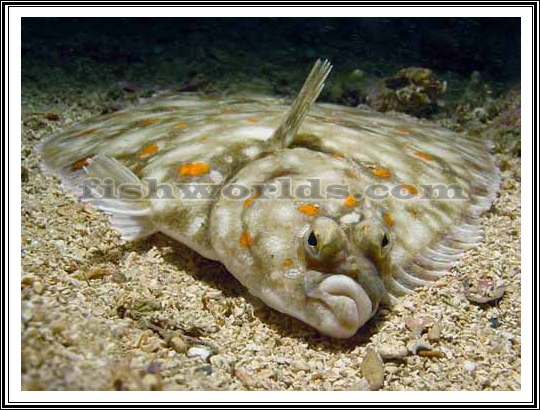
Next to the fish is also called fish demersal flatfish with a wide distribution, covering the Persian Gulf and the east coast of Africa to Japan, north to the south coast of Australia and the Indo-Pacific. This flatfish have the ability to disguise her body with the surrounding environment as camouflage, so the prey can be manipulated and can be easily captured. Usually these fish to bury his body in the mud or sand on the seabed, while the only eyes that come to the surface.Her eyes can be raised or lowered and moved freely. Without prompting, he very patiently waiting for their prey until the prey is really close and careless, with a very rapid movement and sudden ambush, rarely prey can escape from his ambush. Morphological adaptation is a very useful first fish to protect themselves from larger predators and prey both to facilitate it.

 Scientific classification

Next to the fish belonging to the order Pleuronectiform. The Order consists of a variety of species. Based on the findings of European researchers have collected as many as 28 species of flatfish (flatfish), and there are only 6 species of high commercial value, namely Botidae (Bothus ocellatus), Cynoglossidae, Citaridae, Pleuronectidae (Pseudorhombus arsius), Scoftalmidae (Scophtalmus rhombus) , and Soleidae. Soleidae family consists of two species, namely Achiroides leucorhynchos and Achiroides melanorhynchus which belong to the genus Achiroides. The other type is Psettodes erumei, Engyprosopon sp, and Psetta maxima.


Morphological traits

The morphology of fish has a flattened body shape, both eyes are on one side, the other side being no eye (that's why this fish called flatfish) and a little pigment. Length of these fish average about 30 cm and can reach 45 cm. These fish are found in estuaries and shallow water, sand or mud at the bottom to a depth of 200 m. Next to young fish commonly found in brackish water. Major food fish are benthic animals, generally the crustaceans and invertebrate.

Asymmetrical shape that of the adjoining fish flatfish skull is the result of gradual evolution. This is reinforced by the discovery of fossils of a strange-eyed fish from the waters of ancient Europe. This fossil, which lived 50 million years ago, with one eye on his head and the other is next door. The asymmetrical shape allows them to lie flat on the ocean floor while waiting for prey. Flatfish fossils are also found in museums in England, France, Italy and Austria. The fish live in warm shallow waters in Europe in the Age of Eocene Epoch when the world was temperate, as well as whales and a new modern birds first evolved.

Next to the fish usually spawn in offshore areas and there are spawn in estuaries. In all reproductive females are able to release several hundred thousand eggs up to two million eggs. The eggs will be sized larvae from 1.5 to 3 mm. At the time he was a flatfish larvae to mature, more and more shaped flat body, while one of his eyes moving towards one side of his body. After the lower body color changed to white.

Nutrient content of fish is quite high and it is also delicious, the fish flesh side is not too thick but it was very tasty. This fish is also believed to improve stamina. Next to the fish usually exported in the form of fillets with EU objectives. Types are in demand and have a high selling price is Psetta maxima. Another type of export markets is also having sp Engyprosopon which are found in the waters of Semarang and surrounding areas with the aim of export to Japan.


Engyprosopon sp of interest for export share is larger than 20 cm. To obtain the necessary mesh size larger so that was kind of a great caught and also required the withdrawal speed of larger nets (about 4-5 knots). In addition to fish exported Next door is also consumed in the country, are generally sold fresh or in the form of food (usually fried or cooked flavor tauco).

But keep in mind Fish Next to it also is one of the carriers of pests and diseases of fish. Based on the Decree of the Minister of Agriculture Attachments number: 841/KptsIK.220/7/99 dated July 22, 1999 about the types of Pests and Diseases of Fish Quarantine and Types of Disease Carrier Fish Quarantine, noted that the adjoining fish species Psettodes erumei as carrier / host of epizootic diseases Haemotopotic Necrosis (EHN) caused by indovirus with wide spread area that is America, Europe, Australia, Africa and Asia.
Read more »
Powered by Blogger.