Showing posts with label Ornamental Fish. Show all posts

Corydoras (Corydoras semiaquilus)

Know at a glance Corydoras Fish Ornamental Fish - Overview Know Fish Corydoras - Corydoras is one kind of freshwater fish are much in demand by fans of ornamental fish in Indonesia and can be fishery products for export . Aside from being a freshwater fish , in developed countries Corydoras fish can be used as raw material for the manufacture of cosmetic products . Although this fish originated in Latin America , but it had long since been successfully dibudidayakn in Indonesia. Because of the way of cultivation is relatively simple compared to other fish species and maintenance cycles to reach market size is quite short , this fish is known to be cultivated easily and can even be done in the household though . Morphological features of the fish Corydoras have a body shape that is short and fat . More backs curved than the stomach . Both sides are equipped with a slab of fish body such as the bones are arranged in two rows . This fish has two pairs of whiskers located on the upper jaw and lower jaw as well as the size of its body length can reach 12 cm . Corydoras fish can be cultivated in ponds with dissolved oxygen in the water is low . The condition of water quality parameters are ideal for fish Corydoras life is on : 6-8 pH , water temperature 21.5 - 28oC and 2-25 ppm hardness .

Kingdom :Animalia

Phylum :Chordata

Class :Actinopterygii

Order :Siluriformes

Family :Callichthyidae

Subfamily:Corydoradinae

Tribe :Corydoradini
Genus: Corydoras
Lacepède, 1803


Read more »

Bluefin fish Gurame


Bluefin Gurame fish (Trichogaster trichopterus sumatranus) is a fish of the carp family or Osphronemidae, but before the family Anabantidae calculated. This fish is more commonly in use as ornamental fish in the aquarium of the cultivated.

General


It is a subspecies Trichogaster trichopterus, also known as driestipgoerami but also as a blue gourami. There is also a form of fish farming, Cosby blue gourami (Trichogaster trichopterus Cosby). The scientific name of a blue spray means;

     Trichoderma (-) stomach; cable to the (-) stomach
     Trichoderma (-) pterus, (-) wire cutters
     Sumatra, of Sumatra
 
Description


Color and pattern are very versatile, going green to blue specimen, with transverse stripes, spots or dots. The maximum length is about 15 inches and a side view of a fish egg-shaped silhouette, especially through the long, wide pelvic fins toward the rear. Men and women distinguished by rounded dorsal fin, have both, that the man was pointing. Typical are two long, thin beard wire under the belly, just behind the head. Many copies, but not all, have a three point about as far apart, one at the base of the tail, one in the middle of the side and a third point looks. Money for all subspecies of the species described Trichogaster trichopterus, copies are missing the point.

Scientific classification
Empire      : Animalia (Animals)
Ethnicity    : Chordata (chordates)
Class         : Actinopterygii (ray)
Order        : Perciformes (perch)
Family       : Osphronemidae
Gender      : Trichogaster
Type          : Trichogaster trichopterus
 
Subgroup
Trichogaster trichopterus sumatranus
features

Size 15 cm
Water temperature 22-28 º C
pH 7-7.5
DH 12-16 º
Minimum aquarium size 120 cm 

Lifestyle


For bubblenest reproduction is made​​, lowering the water level did not think fish reproductive period is reached. Blue splash is widely known in the aquarium world because of his taciturn nature, acceptance of a wide range of food and especially the tolerance of the species habitat and some of water quality demands. If the water temperature is between 22 and 28 degrees than optimal. They are a very peaceful fish.  
Read more »

Royal Dottyback


Royal Dottyback - Blue Eye is a new species of Royal Dottyback. The first time you see it, almost indistinguishable from the Royal Dottyback (Pictichromis paccagnellae) in general. However, upon closer inspection, it will find a unique feature that distinguishes Blue Eye Royal Dottyback for this.

This species is known as the Blue Eye Royal Dottyback from Dottyback family. This fish has a distinctive coloration. Habitat of this species in the tropical waters of the western Pacific. Blue Eye Royal Dottyback can be recognized to have typical coloration. The front of bright purple fish, which then suddenly turns yellow on the back of the fish.


If you want to keep in the aquarium it should be housed in a marine aquarium contains 30 gallons or larger in size. Aquascaped ideal setup should be good with live rock to provide enough options crevices and caves. Food from Blue Eye Royal Dottyback should consist of brine shrimp and prepared frozen foods. To maintain the ideal color.

These fish are strong enough may exhibit aggressive territorial behavior towards conspecifics and better kept alone with the exception of the largest home aquarium. In general, the spirit of the Blue Eye Royal Dottyback of this, have an energetic personality and will not be easily intimidated by other fish and even two to three times its size.
Read more »

Pearl Sepat (Trichogaster leeri)


Pearl Sepat (Trichogaster leeri) is a type of freshwater fish carp tribe members (Osphronemidae). In English is called Pearl Gourami, Mosaic or Lace Gourami Gourami refers to the color pattern of beautiful speckled with black stripes on the side of his body.

Pemerian

Flat-bodied fish and narrow pointy snout, tail along the whole length of up to 120mm. Gray or bluish with a grain pattern greenish or similar silvery pearls aplenty. A dark colored band running on the middle side of the body, starting from the tip of the snout through the eye and end up with a rash on the base of the tail. Males are more colorful, the throat and the front of the anal fin is reddish.
Dorsal fin formula, V-VII (of fingers or spines) and 8-10 (soft fingers), and the anal fin XII-XIV, 25-30. 30-37 lateral line of fruit. Standard length (without the tail) is approximately 2.4 times the height. A pair of leading edge radius on the pelvic fins turned into a tentacle-like whips or crops, which extends into the tail, complemented by a pair of short spines and 2-3 tassels.


Agihan and habitat

Snakeskin pearls spread from Thailand, Malaysia, Sumatra, Kalimantan up. These fish are residents of low-lying marshes that aqueous slightly acidic. These fish are usually happy to be close to half the depth of the water surface.

Maintenance in the aquarium
 
Size and condition
To maintain a pair of pearl Sepat should use ponds or aquariums are at least 60 liters; bigger size would be better, because these fish will show symptoms of stress when feeling constrained office. The water temperature should range between 22-28 ° C (72-82 ° F). Surface water should be in direct contact with the open air, so that the fish labyrinth organ to function properly. Aquarium completeness required of them was appropriate substrate and ornaments, water plants, water filters, lighting, and maintenance.
Snakeskin pearl is a peace-loving fish. This fish can live mixed with other types of fish, but you should not be combined with fish that are aggressive or overly active. Also need to be maintained so that the aquarium is not too full of pearls Sepat is not perturbed. The sign, Sepat male can suddenly attack or bully other fish that was bothering him.
woof
Snakeskin pearl is an omnivore, eating everything. In the aquarium, the fish can be fed dry as pellets or dried tubifex worms. Every now and then, can also be given live food such as tiny shrimp.

Spawning


To spawn spot, aquarium need to be equipped with floating water plants. Here the male fish will make a nest or hive foam bubbles of saliva, as a place to spawn and keep egg to hatch later. Courtship and spawning will take place in the nest, and after the egg is released and fertilized, the female Sepat will be driven out by the male. As with other types Sepat, the male will guard the pearl Sepat these eggs to hatch.
Once spawning females usually will issue 150-200 eggs. Fish eggs will hatch after 24 hours later. The next couple of days to seed (the children of fish) begin actively swimming. At that time the male fish should be separated from their children, so that seed-seed is not eaten. Children can fish initially fed microscopic shrimp, and the following weeks can be fed dry mashed.
 
Read more »

Chinese Sturgeon ( Acipenser sinensis )

Chinese Sturgeon (Acipenser sinensis) is a member of family acipenseridae and one species anodromous great. Anodromous mean adult fish live in the ocean and return to rivers to spawn. They belong to one of 27 species of sturgeon that still exist in the world. Chinese sturgeon has existed on earth since 140 million years ago and is one of the vertebrate oldest who has lived from the time between chondrichthian and bony fish.
Taxonomy

Kingdom   : Animalia
phylum      : chordates
Class         : Actinopterygii
order         : Acipenseriformes
Family       : Acipenseridae
genus        : Acipenser
species      : Acipenser sinensis
 
Due to the long period of his life that this fish is often referred to as a living fossil. Once the fish are scattered in some point in East Asia such as Korea, Japan and western Kyushu in the Yellow River, Yangtze, Pear, Mingjiang and Qingtang in China, but now impossible to find these fish in that place except in the waters of the Yangtze River below the Gezhouba Dam China. Chinese sturgeon is classified as endangered animals in China's first level equal status Panda Bear. The fish population is estimated at about 10,000 birds in the 1970s and lived 203-257 tail in 2005-2007. These data showed a decrease in population of approximately 97.5% over 37 years. Status of the fish is also listed in the IUCN Red List status with categories "Critical Endangered". Fish are considered by the Chinese as a national treasure begin preserved. China alone has built Chinese Sturgeon Museum is located on the island in the river Xiaoxita Huangbo. This museum is a government institution to protect these fish and also as a place of learning including fish breeding techniques. Beginning in 1983-2007 has been released around 9 million baby fish into Yangtze River to increase the population.

 According to experts, the transition between the sturgeon is a species of cartilaginous fish with a true bony fish. This suspicion arises because the fish that have appeared in the Cretaceous era. Chinese sturgeon has a fairly large body size even regarded as the king of freshwater fish in the biggest and longest lifespan. Adult fish can reach a length of 4 meters with a weight of 500 kg and age may exceed 14 years. This fish has the physical characteristics of the conical head shape, body colored silver-black, the mouth of which is located under the jaw and had barbells. There is a set of bones that stand out like thorns that became known as Osteones well in the center of the head and the stomach lining from the tip of his nose. The fish's body is covered with at least five osteones line. Info about engineering maintenance on the tank has not been found, given that the threatened status of this fish and have a declining population trend.
As with Salmon, Chinese Sturgeon is a fish that migrate in groups of oceans to rivers to spawn or known as Anodromous. Adult fish will reach the downstream Yangtze River during the month of June-July and they will not eat when it's in the river. They will only reach the middle of the river when september-october. Total distance they traveled ranged 2500-3300 km. After reaching the destination with the condition of benthic nurseries rippling water with rocks and steep ravines, they will begin to release eggs. Fertilization occurs externally fertilized eggs and the percentage of success is less than one percent. This fish has a poor reproductive capacity, they will only spawn three or four times during his life and female fish carrying around a million eggs in a single pregnancy. Eggs are large enough and then sunk into the ground until they hatch. After hatching, they will go down to the sea coast to the downstream or until they grow large enough. In this environment the baby fish are the main food zoobenthos and other basic aquatic invertebrates. Chinese young sturgeon are carnivores with the main meals are all water animals, but as adults they tend to prey on the larvae, insects and humic substrates. Chinese sturgeon is known to use at the end of the upper lip kemosensor to detect food. Maintenance as pets fish still should not be done because its status is still conserved. In addition, the behavior of fish that also live in the sea and migrators will also troublesome during maintenance.
There are several factors that led to a drastic decline in population of Chinese sturgeon, among others:

1. The construction of hydropower projects on the Yangtze river downstream Gezhouba Dam, this causes loss of fish migration path to reproduce

2. Contamination that occurred in the Yangtze River by hazardous chemicals. Research conducted Jianying Hu et al, mentioned that in the liver chinese sturgeon found Triphenyltin compounds (TPT) approximately 31-128 ng / g. TPT is a pesticide compounds that can cause malformations in larval fish.

3. In addition to the construction of Gezhouba Dam, the construction of about 106 bridges and sluice gates on the Yangtze river also automatically cut off the fish migration.

4.
Amount of water transportation vehicles and overfishing directly reduce the number of population.
Conditions endangered Chinese sturgeon were so forbidden to catch or keep the fish in order to maintain its population in the wild.
   
Read more »

Channa Barca


Do you know the fish are named Channa Barca??? Snakehead fish Channa Barca is the most expensive and the most beautiful in the world. Channa Barca has a shape that is quite unique when compared to other types of Snakehead.
Very long flowing fins with orange color at the edges, the color turqouise colored body, a unique head shape and the price is very expensive is its uniqueness. Channa Barca are rare, these fish can only be found in the area Goaparla, India. These fish live in burrows dug, natural foods are shrimp, crabs and small fish. Channa Barca berhabitat in subtropical climates in the temperature of 17-20 degrees Celsius. Goalpara cork comes from a small town on the banks of the river and there are also in india bangladesh. This fish can grow up to 90cm. Life temperatures around 18c. PH 6.5-8.0

Scientific classification
Kingdom     : Animalia
Phylum        : Chordata
Class          : Actinopterygii
Order         : Perciformes
Family        : Channidae
Genus         : Channa
Species       : C. barca
binomial name
Channa barca
(Hamilton, 1822)

Channa Barca is a very exotic fish when kept in your tank. Around the world, only a few people who maintain Channa Barca. Currently, the majority owner of Channa Barca are struggling to make an effort so that the number of breeding Channa Barca wild population does not continue to be hunted to extinction.


Many people complain about the price Channa Barca are very expensive. This is because:

Channa Barca are very rare, this fish can only be found in the area Goaparla, India. Channa Barca habitat areas are conflict-prone areas. Channa catching Barca in the area because it requires great courage to bet their lives. Despite successfully reached Channa Barca habitat areas, may not be able to find it. These fish live in burrows, so it's hard to get it cheap fish. If forced to catch Channa Barca with careless technique, it will result in the death of the fish. Moreover, not all holes inhabited by Channa Barca. Many holes that upon inspection, it was empty.
Read more »

Fish Betutu (Oxyeleotris marmorata)


Betutu (Oxyeleotris marmorata) is the name of a type of freshwater fish. Although somewhat rare large, fish spread in Southeast Asia to the archipelago favored anglers because betotan (pull) her strong and sudden.
 

Other names in various regions in Indonesia is Bakut, bakutut, belosoh (common name), boso, boboso, bodobodo, fish stupid, stupid cork, ketutuk, lazy fish, fish and other ghosts. In English is called marble or marble goby sleeper, referring to the color patterns on its body similar reddish marble.

Introduction


Small to medium-bodied fish with a large head. Body length (SL, standard length) to a maximum of about 65 cm, but most only between 20-40 cm or less. Faded brick red, brown or blackish, with dark patterns on his body symmetrical. Without spotting round (ocellus) at the base of its tail.

Dorsal fin (back) are next to face with six fingers hard (thorns), and the rear door with the spines and nine soft fingers. An anal fin with 7-8 spines and soft fingers. The scales in the middle of the back, from the back of the head to the base of the dorsal fin (supraneural scales) 60-65 pieces. The scales on the sides of the body, along the lateral line (lateral row scales) 80-90 pieces.

As reflected by its name, this fish lazy to move or migrate. He tends to say anything in the bottom waters, even harassed. Only at night betutu somewhat active, chasing shrimp, small fish, crab, or a water snail. Betutu fish found in the rivers at the sheltered, swamps, reservoirs, waterways or ditches.


Deployment


 Betutu spread in Southeast Asia: Thailand, Vietnam, Cambodia, Laos, Malay Peninsula, the Philippines, and Indonesia: Sumatra, Kalimantan, Sulawesi and Maluku. Is also found in Java. Introduced to Singapore, Taiwan, China, and perhaps also Fiji.
Betutu favored fish as well as fish fishing fish consumption. Meat is tasty and tender.

scientific classification
Kingdom: Animalia
Phylum: Chordata
Class: Actinopterygii
Order: Perciformes
Family: Eleotridae
Genus: Oxyeleotris
Species: O. marmorata
Read more »

Chinese High Fin Banded Shark ( Myxocyprinus asiaticus )


Chinese High Fin Banded Shark / Chinese Sucker Fish (Myxocyprinus asiaticus) is also known by the Chinese hi fin or Sailfin Sucker, Sucker Asian, and Entsuyui. This fish comes from the Yangtze River in China and is one of the most primitive members of the family Cyprinideae.
 
Chinese Hi Fin considered a true sucker fish with lips form a small bear, fat, thick and without barbels. In addition, the Chinese Hi Fin has a single row of pharyngeal teeth that have been arranged.
In the wild, these fish can reach the size of 39 inches with a weight of 40 kg, while the average size aquarium that can be achieved is around 18-24 inches. Tank water temperature suitable for Chinese Hi fin range is 65 ° to 75 ° F (24 ° C) and pH 6-7, therefore the fish are cold water fish such as koi and goldfish. Chinese Hi Fin are omnivores to eat algae, shrimp, invertebrates, blood worms and others. Chinese Hi Fin young silvery colored with Black stripe on his body, with age, the color changes to make the fish is dark gray to reddish. The process of breeding in the aquarium not been reported but it is known that these fish are adherents egglayers.


Taxonomy
 
Kingdom      : Animalia
phylum         : chordates
Class            : Actinopterygii
order            : Cypriniformes
Family          : Catostomidae
genus            : Myxocyprinus
species         : Myxocyprinus asiaticus

Chinese Hi Fin has a distinctive dorsal fin is high and shaped bracket that extends up the anal passage. Differences in male and female fish known as the adult, male fish brightly colored red with crimson vertical body lines, while the female fish with a dark purple reddish body lines.
Read more »

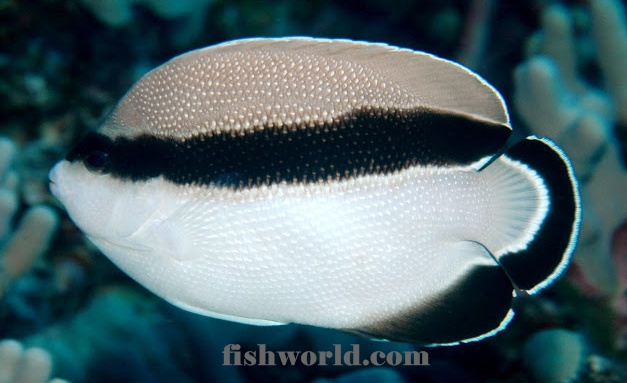
Angelfish Griffis ( Apolemichthys griffisi )


Angelfish Griffis (Apolemichthys griffisi) found within a limited range in the Indo West Pacific. Habitat Angelfish Griffis typical coral and deep on slopes or walls. Although not too flashy in color, Angelfish Griffis has a unique and striking patterns of the signs. It is most suitable for large aquariums without cnidarians or sponges that can tempt Angelfish Griffis to bite.

 
Griffis angelfish often found in coral reef slopes and sharp drop-0ff. They often live in solitary pairs or in small groups and do not migrate. Griffis angel fish live in the depths of 15m to 100m, ideally usually encountered at a depth of 40m to 60m below sea level.


Griffis Angelfish have time to breed between the ages of 1.4 years to 4.4 years. The main food Griffis Angelfish is a sponge and tunicate. It's fun when the ornamental fish Angelfish Griffis which we maintain in the reef aquarium would eat artificial foods like fish pellets.

Apolemichthys griffisi
Scientific classification

Kingdom       : Animalia
Phylum          : Chordata
Class             : Actinopterygii
Order           : Perciformes
Family          : Pomacanthidae
Genus           : Apolemichthys
Species         : A. griffisi
binomial name
Apolemichthys griffisi
Read more »
Powered by Blogger.